
Every time interest rates start to drift down, the same question comes back into my inbox:
“Should I switch to floating now?”
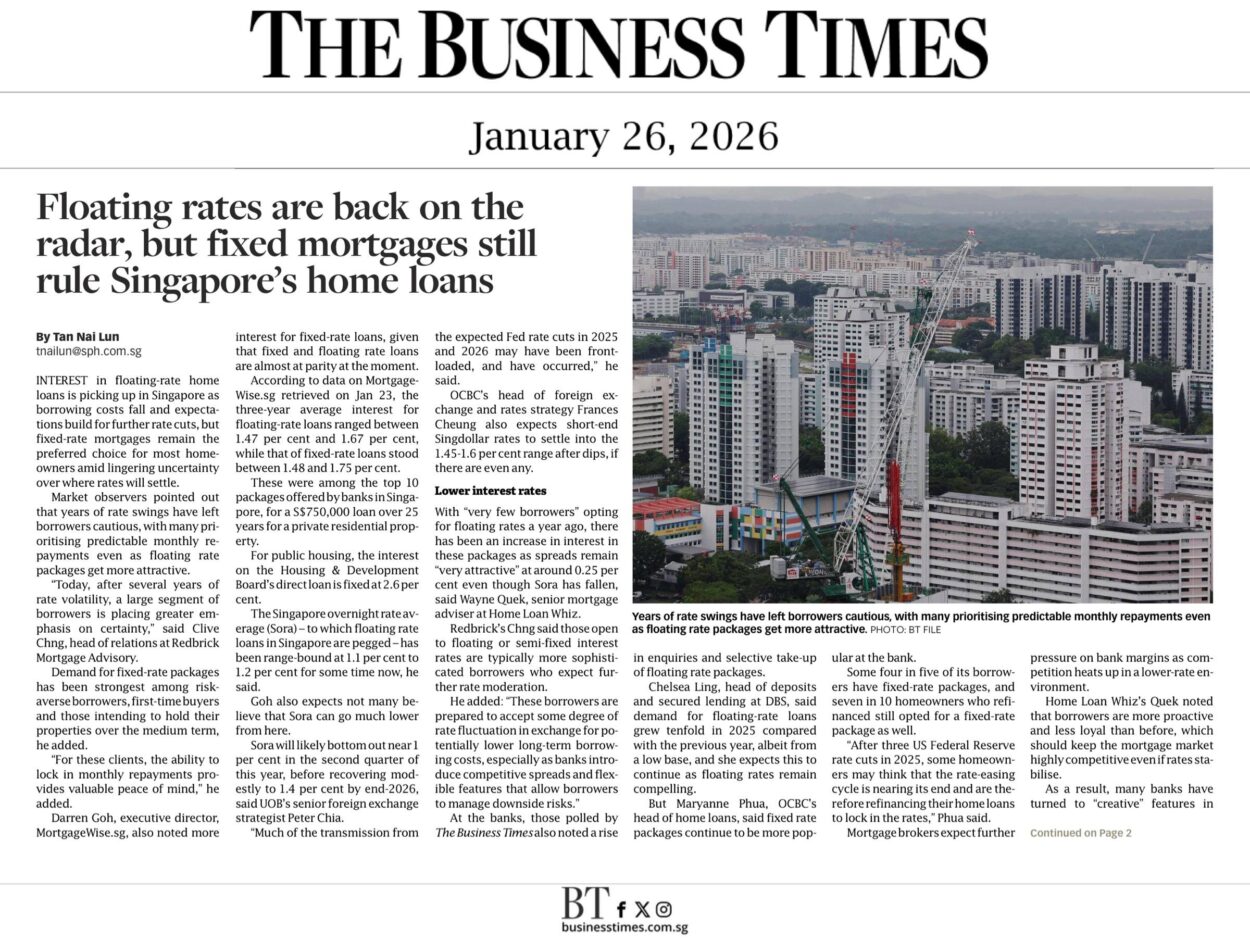
The Business Times piece (Jan 26, 2026) basically confirms what I’m seeing on the ground: floating-rate interest is picking up again, but fixed-rate mortgages still dominate in Singapore because most homeowners are still choosing certainty over cleverness.
And honestly? For many families, that’s not a “boring” decision — it’s a smart one.
What the article is really telling us
From the article’s numbers and banker commentary, a few signals stand out:
- Floating rates are becoming attractive again as borrowers expect rates to ease further.
- Yet the majority still choose fixed packages because they want predictable monthly repayments.
- More borrowers are also behaving like “rate shoppers” now — refinancing, repricing, and switching packages faster than before.
That last point is big: the Singapore mortgage market has matured. Borrowers today are more proactive, and banks are getting more competitive (sometimes with “creative” features) to win your loan.
The case for fixed rates: why most homeowners still choose it
Let me say this clearly:
If you’re buying a home to live in — fixed rate is still the default “best decision” for most people.
Why?
- Peace of mind is worth money.When you’re managing kids, parents, renovation loans, insurance, and daily life… the last thing you want is repayment uncertainty.
- Singaporeans don’t like payment shocks — and that’s rational.Even if floating might drop later, the psychological and cashflow cost of “what if it doesn’t?” is real.
- Fixed packages help you plan your next move.Most homeowners don’t just buy once. They upgrade, right-size, or restructure. Fixed rates help you forecast your runway.
So yes, fixed “still rules” — not because people are ignorant, but because certainty matches most households’ real priorities.
The case for floating rates: when it actually makes sense
Now, floating rates aren’t “bad.” They’re just not for everyone.
Floating can be a strong option if you tick these boxes:
- You have cash buffer (at least 6–12 months of mortgage repayments set aside).
- Your income is stable and you can tolerate fluctuations.
- You’re the type who will monitor and refinance/reprice actively.
- You’re planning to hold the property medium-long term, and you believe the rate cycle is easing.
In other words: floating is often best for sophisticated borrowers — investors, high-savings households, or owners who treat financing as a strategy, not a set-and-forget decision.
My stance: fixed first, floating second — unless you’re truly set up for it
Here’s my honest opinion as an agent who watches buyer behaviour and affordability trends closely:
For 80% of owner-occupiers, fixed (or semi-fixed) is still the more responsible choice — even when floating gets “tempting.”
Because most people don’t lose money on interest rate differences.
They lose money when rate uncertainty causes:
- stress-driven decisions,
- rushed refinancing,
- over-stretching on purchase price,
- or holding regret (“I shouldn’t have bought so big”).
That said, I’m seeing a growing middle group — people who want the best of both worlds:
✅ Semi-fixed / short fixed periods (e.g., 1–2 years fixed, then review)
✅ Packages with flexible repricing or refinancing paths
✅ Strategic timing around lock-in periods so they can move when rates shift
This is the “new normal” borrower: still cautious, but smarter and more active.
The one thing most borrowers forget: your loan package must match your property plan
This is where I get blunt with clients:
A mortgage is not just a rate — it’s a plan.
Before choosing fixed vs floating, I always ask:
- Are you staying 3 years or 10 years?
- Are you upgrading?
- Are you planning to rent it out later?
- Are you stretching your budget today to buy “future growth”?
Because if your property plan changes, your loan should support that change — not trap you with penalties, lock-ins, or bad flexibility.
What this means for you
If you’re choosing a home loan in 2026:
- If you’re buying to live in: fixed or semi-fixed is still the safer, calmer default.
- If you’re financially buffered and proactive: floating can work, but only if you’re prepared to manage it like a strategy.



Leave a Comment