

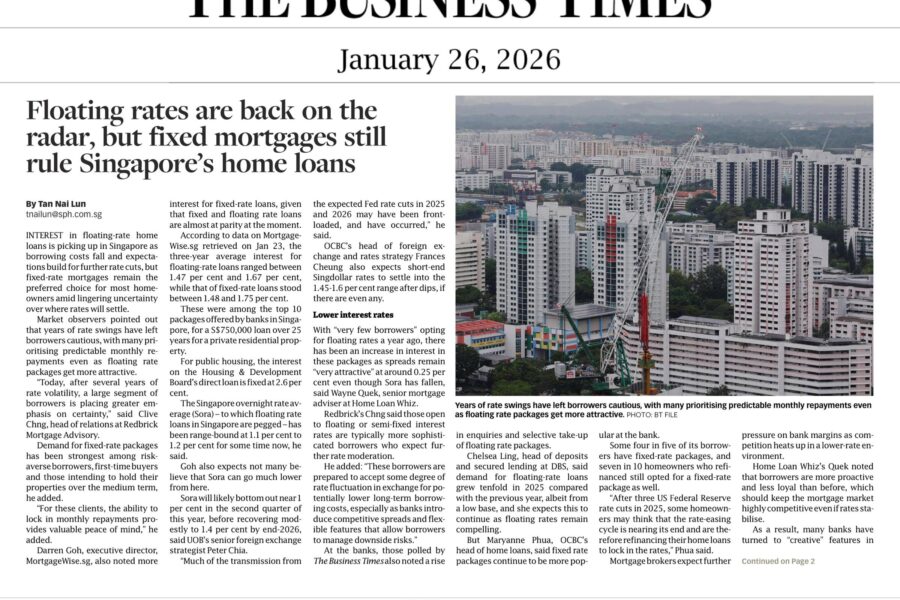
When people talk property, most will look at condos and HDB first. But this Business Times update on office rents rising and vacancies falling is something I always pay attention to — because office demand is basically a “business confidence” indicator.
If companies are renewing leases, expanding, and taking up space, it usually means:
- hiring is more stable
- business activity is healthier
- and the city core stays attractive
And when the city core stays attractive, it doesn’t just affect office landlords — it can spill into residential rents, city-fringe demand, and investor confidence.
My view: this is a supportive sign for Singapore property sentiment, but it doesn’t mean everything will surge. It means we’re entering a more “selective, quality wins” phase again.
What the article is saying in simple terms
Here’s the plain English version:
1) Rents went up in Q4
URA’s office rental index for the central region rose in Q4 (the article says +0.4%).
That’s not a massive jump — but it tells me landlords still have some pricing power.
2) Empty office space is shrinking
The vacancy rate for Category 1 offices fell to 9.3%, and it has been falling for three quarters in a row.
Translation: the market is slowly absorbing space.
3) Supply is tightening
The headline itself says “as supply tightens”, which usually means either:
- not many new office completions at once, or
- demand is catching up faster than expected, or
- both.
My stance: “Office rents up + vacancies down” is a confidence signal — not a hype signal
This is important.
Some people will see this and say:
“Wah, economy strong, property confirm up.”
I wouldn’t jump that far.
What I do believe is:
✅ It supports Singapore’s ‘business hub’ story
✅ It reduces the chance of a “weak sentiment” spiral
✅ It keeps prime areas relevant (CBD / Marina Bay / Raffles Place / Tanjong Pagar type zones)
But it also means:
⚠️ Companies may become more cost-conscious
⚠️ Smaller firms might move to cheaper buildings / city fringe
⚠️ Not every building benefits equally
So I see it as a positive base, not a “rocket launch”.
The bullish side: why this is good news
If office rents can rise while vacancies ease, it suggests demand is real.
That tends to support:
- commercial asset values (office owners feel more confident)
- investor sentiment (less fear of oversupply)
- prime district activity (more workers, more spending, more movement)
- city-fringe residential rentals (people who want shorter commutes still pay for convenience)
If you own or invest near strong business nodes, this kind of data often helps hold pricing and rental demand steady.
The cautious side: who may feel the pain
Higher office rents are not good for everyone.
If you run a business, especially SME:
- higher rent = higher fixed cost
- and that can lead to downsizing or relocation
This is where you might see a “split market”:
- Prime, modern, well-located offices do well
- Older / less efficient buildings may need to compete harder (incentives, fit-out, pricing)
So yes, the office market can strengthen — but it’s usually uneven, not across-the-board.
The hidden link to residential property (why homebuyers should care)
Here are 3 ways office trends affect homes:
1) Jobs and confidence
If businesses are still taking space, it signals stability. That matters because housing decisions are emotional — people buy when they feel secure.
2) Rental demand patterns
Strong office nodes support rental demand in:
- city fringe
- MRT-connected areas
- lifestyle hubs with easy commute
3) Buyer preferences shift
When commuting gets more important again (more office time), buyers start valuing:
- shorter commute
- transport convenience
- liveability near business areas
That can quietly lift demand for specific pockets, even if the overall market stays “steady”.
What this means for you
If you’re a buyer (own stay):
This supports the idea that Singapore remains stable as a business base. If your work is city-linked, prioritise commute and convenience — that’s what holds long-term value.
If you’re an investor:
Don’t just buy “any condo”. Buy what tenants actually want: MRT access, practical layout, reasonable entry price. Office strength supports rental demand, but only good units convert into real rent.
If you’re a seller (especially city / city-fringe):
Use this narrative properly: “business confidence is returning” — but price to reality. Buyers still compare a lot.
Takeaway:
Office rents rising + vacancies falling is a confidence signal. It supports property sentiment, but it will reward quality and location, not “anything also can”.

Leave a Comment